Modeling Community Visions for a Future Without the BQE
Workshop
Monday June 22, 2026
Van Alen Institute
303 Bond St,
Brooklyn, NY 11231


On Monday, June 22nd we held a free Modeling Community Visions for a Future Without the BQE Workshop at Van Alen Institute.
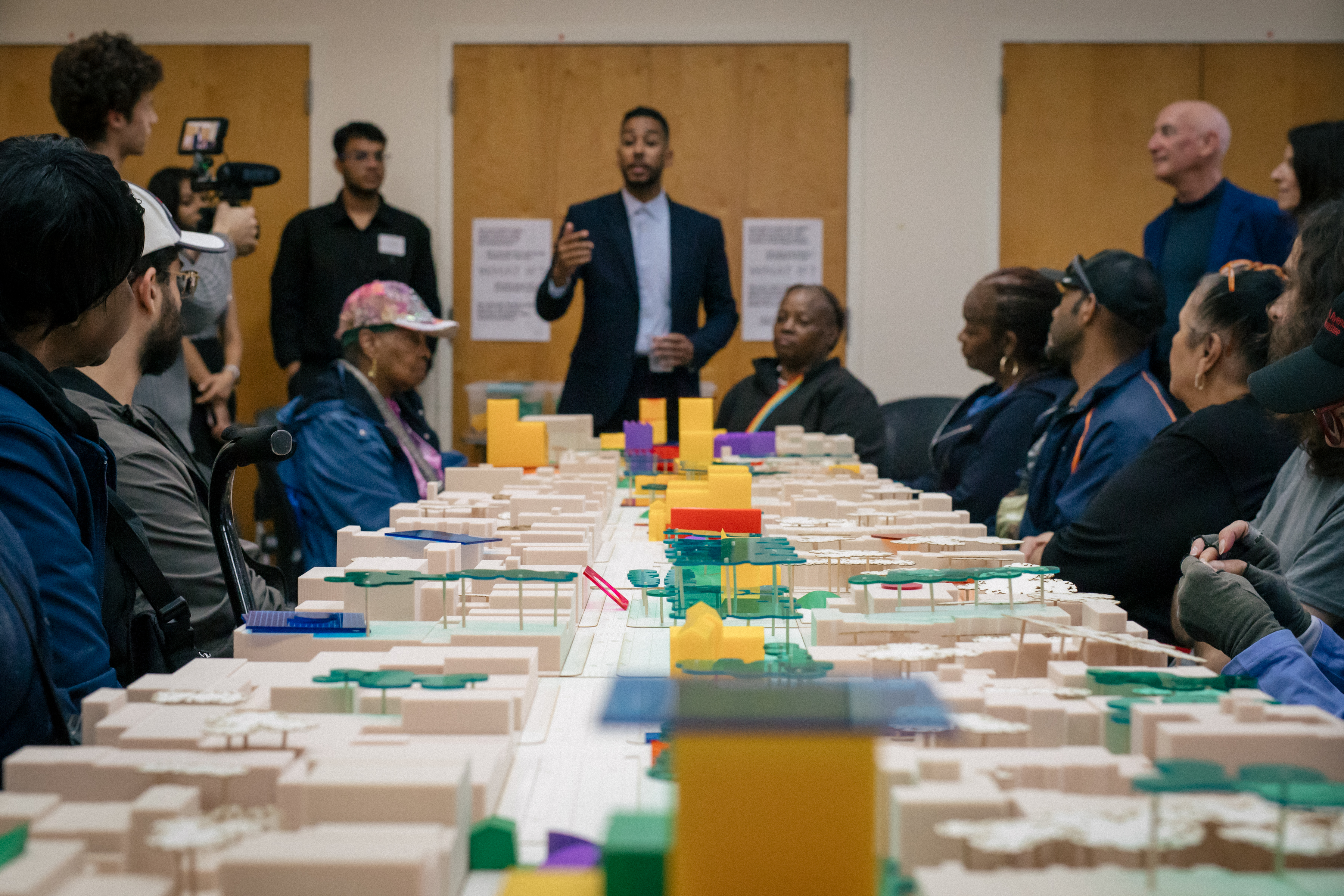
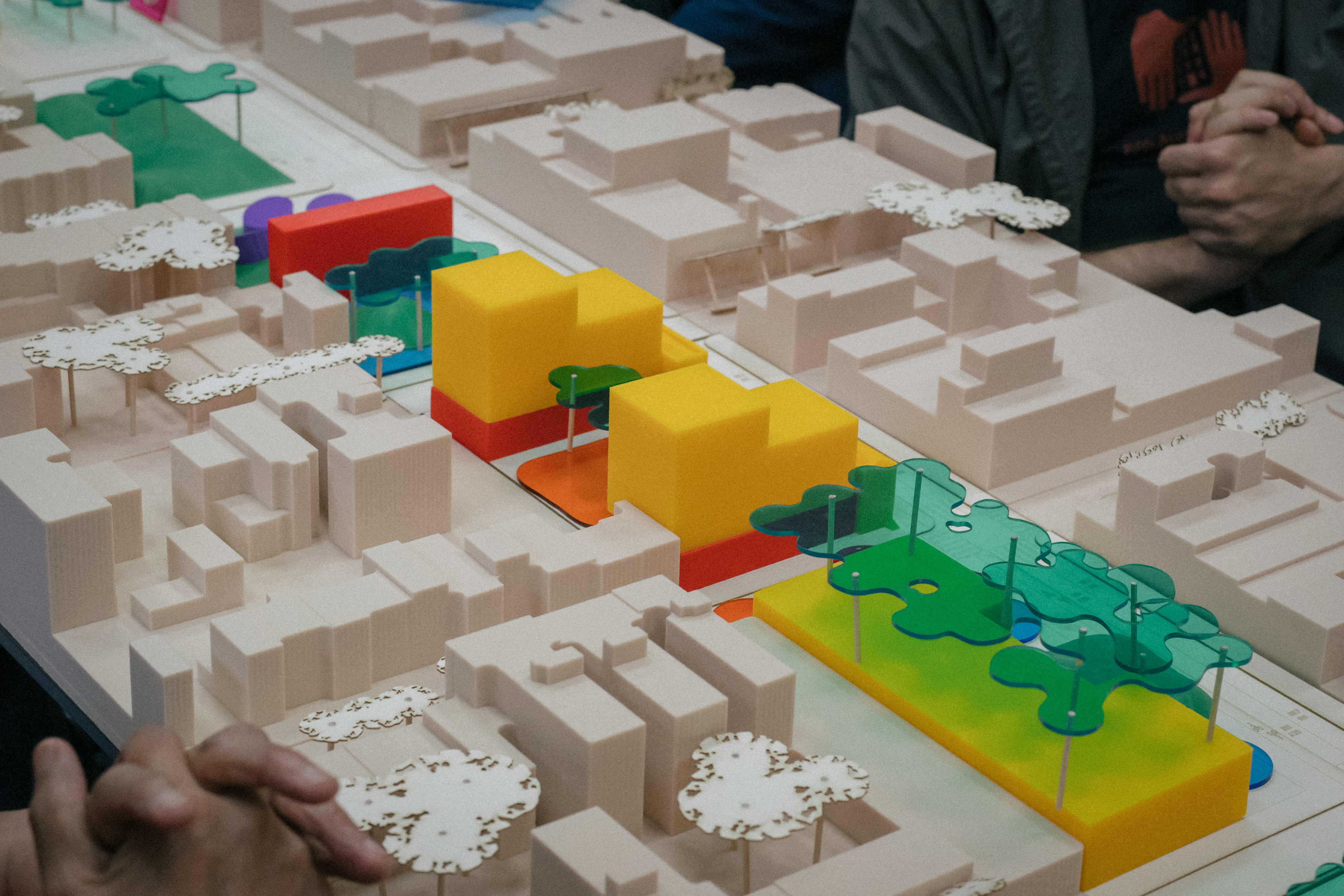
The Institute for Public Architecture with Van Alen Institute, Red Hook West Resident Association, and Pave Academy Charter School invited participants to a series of community design workshops where Brooklyn residents were invited to modify large scale physical models of the urban fabric along the Brooklyn-Queens Expressway (BQE) in Red Hook/Carroll Gardens. Using a removable kit of parts including buildings, landscapes, and alternatives to the highway, participants shared their visions for the future of their neighborhoods.
Modeling Community Visions for a Future Without the BQE is a series of free and open to the public community design workshops where Brooklyn residents reimagine their neighborhoods in a vibrant post-BQE future.
“If the future BQE, with freight moved to rail and water, were to become a tree-lined street rather than a six-lane highway that divides and pollutes neighborhoods, what would communities want to do with this newly available ‘land bank'?”
The divisive and polluting BQE, built by Robert Moses from 1937 to 1964, is falling apart. With repairs projected to cost billions of dollars for the triple cantilever alone, community groups have amplified their call for a holistic rethinking of the entire BQE corridor. To support that effort, the IPA, led by fellow Marcus Wilford, is developing large-scale detailed physical models of neighborhoods adjacent to the BQE. The models, with a removable kit of parts including housing, civic, industrial, and landscape typologies, and alternatives to the highway, are modified by workshop participants, with their proposals documented and shared with local leaders and elected officials. Workshops include presentations by Adam Paul Susaneck, founder of Segregation by Design, featuring specific buildings, civic spaces, and social groups in the neighborhood that were destroyed by the construction of the highway.
In 2025, the IPA modeled BQE-adjacent neighborhoods along 3rd Avenue in Sunset Park in partnership with Fifth Avenue Committee and Community Board 7. The project continues this year with modeling workshops in Red Hook & Carroll Gardens, where the BQE runs on an elevated viaduct above Hamilton Avenue before it descends to the Hugh L. Carey Tunnel and turns north to become a trench along Hicks Street.
The project is supported by the New York State Council on the Arts with the support of the Office of the Governor and the New York State Legislature; by public funds from the New York City Department of Cultural Affairs in partnership with the City Council; New York Institute of Technology, School of Architecture & Design; and private donations.
The Institute for Public Architecture with Van Alen Institute, Red Hook West Resident Association, and Pave Academy Charter School invited participants to a series of community design workshops where Brooklyn residents were invited to modify large scale physical models of the urban fabric along the Brooklyn-Queens Expressway (BQE) in Red Hook/Carroll Gardens. Using a removable kit of parts including buildings, landscapes, and alternatives to the highway, participants shared their visions for the future of their neighborhoods.
Modeling Community Visions for a Future Without the BQE is a series of free and open to the public community design workshops where Brooklyn residents reimagine their neighborhoods in a vibrant post-BQE future.
“If the future BQE, with freight moved to rail and water, were to become a tree-lined street rather than a six-lane highway that divides and pollutes neighborhoods, what would communities want to do with this newly available ‘land bank'?”
The divisive and polluting BQE, built by Robert Moses from 1937 to 1964, is falling apart. With repairs projected to cost billions of dollars for the triple cantilever alone, community groups have amplified their call for a holistic rethinking of the entire BQE corridor. To support that effort, the IPA, led by fellow Marcus Wilford, is developing large-scale detailed physical models of neighborhoods adjacent to the BQE. The models, with a removable kit of parts including housing, civic, industrial, and landscape typologies, and alternatives to the highway, are modified by workshop participants, with their proposals documented and shared with local leaders and elected officials. Workshops include presentations by Adam Paul Susaneck, founder of Segregation by Design, featuring specific buildings, civic spaces, and social groups in the neighborhood that were destroyed by the construction of the highway.
In 2025, the IPA modeled BQE-adjacent neighborhoods along 3rd Avenue in Sunset Park in partnership with Fifth Avenue Committee and Community Board 7. The project continues this year with modeling workshops in Red Hook & Carroll Gardens, where the BQE runs on an elevated viaduct above Hamilton Avenue before it descends to the Hugh L. Carey Tunnel and turns north to become a trench along Hicks Street.
The project is supported by the New York State Council on the Arts with the support of the Office of the Governor and the New York State Legislature; by public funds from the New York City Department of Cultural Affairs in partnership with the City Council; New York Institute of Technology, School of Architecture & Design; and private donations.